

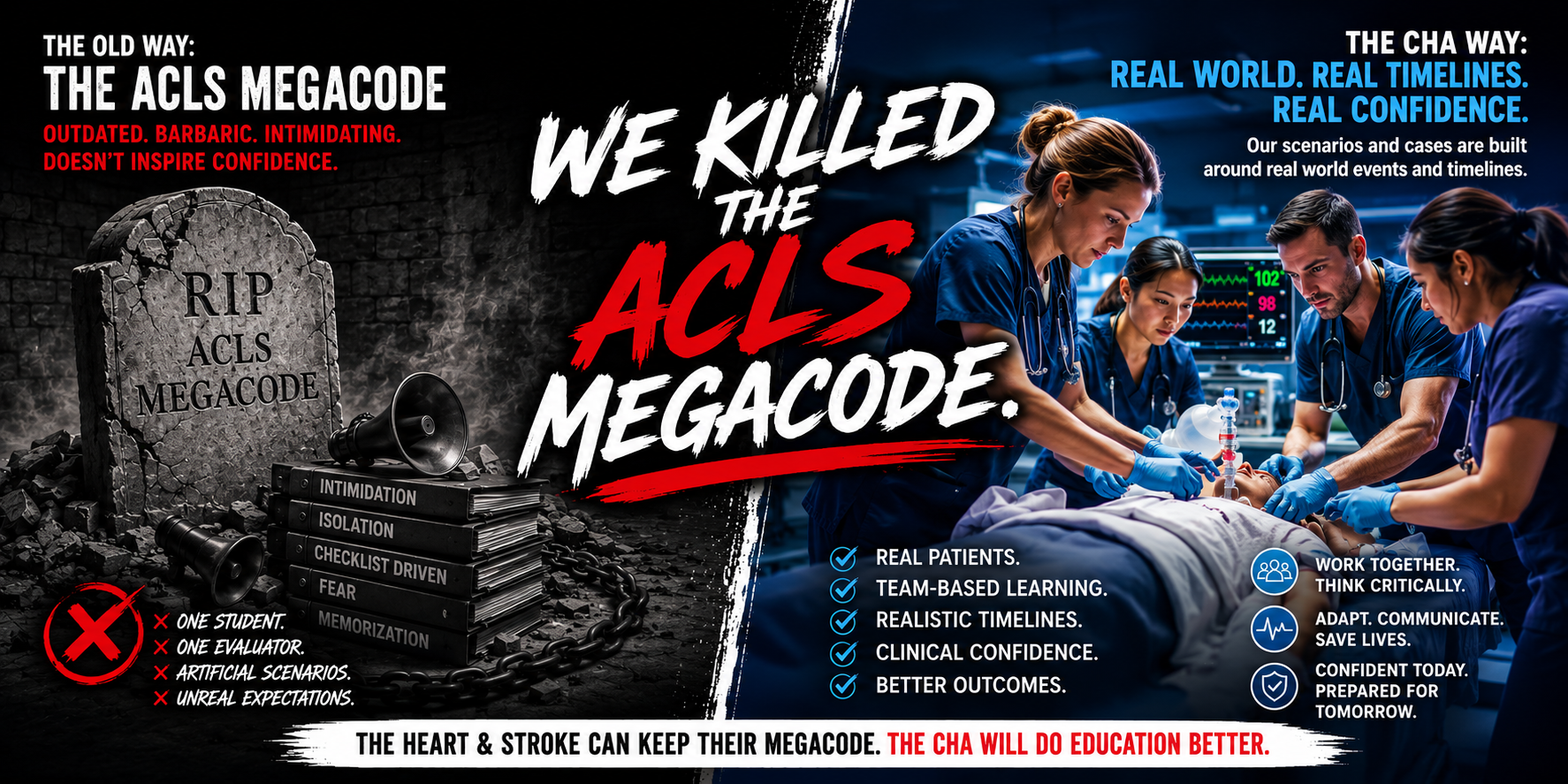
We Killed the ACLS Megacode
For decades, the ACLS megacode has been treated like the gold standard of resuscitation education. One student. One evaluator. A rigid, high-pressure scenario designed to “test” performance under stress.
At the Canadian Heart Association, we made a deliberate decision:
We killed the megacode.
Why? Because healthcare professionals deserve better than an outdated educational ritual built around intimidation, memorization, and performance anxiety.
The Problem With the Traditional ACLS Megacode
The classic megacode model was created in a different era of education — one where humiliation and pressure were often confused with “high standards.”
In many traditional programs, participants are placed into artificial scenarios designed less to teach and more to catch mistakes. Learners are expected to perform in front of peers while being evaluated in a rigid pass/fail format that rarely reflects how real resuscitation events actually unfold.
The result?
Increased anxiety
Reduced confidence
Memorization instead of understanding
Fear of making mistakes
Unrealistic expectations of clinical performance
Real cardiac arrests are not scripted. Real healthcare teams do not function like examination checklists. And real learning does not happen when people are afraid to speak, think, or ask questions.
The truth is simple:
The megacode does not build confidence. It builds stress.
Real Healthcare Is Team-Based — So Why Isn’t ACLS Training?
Modern healthcare depends on communication, leadership, adaptability, and teamwork. Yet many ACLS megacode evaluations isolate learners into artificial situations where they are expected to “perform” rather than learn.
That approach fails to prepare providers for what actually happens in emergency medicine.
At the Canadian Heart Association, we redesigned ACLS education from the ground up.
What We Do Instead
Our ACLS education programs are built around:
Real-world patient presentations
Progressive patient deterioration
Dynamic team communication
Clinical decision-making
Case-based learning
Realistic timelines and evolving scenarios
Instead of forcing learners through a rigid “gotcha” exercise, we immerse them in practical clinical events that mirror what healthcare professionals actually encounter.
Our participants manage:
deteriorating patients,
respiratory emergencies,
unstable arrhythmias,
cardiac arrest events,
post-resuscitation care,
and complex team dynamics —
all within realistic scenarios that evolve naturally over time.
This creates something the megacode never could:
True clinical confidence.
Education Should Build People Up — Not Tear Them Down
We believe healthcare education should challenge learners without humiliating them.
A strong ACLS provider is not someone who can recite algorithms under intimidation. A strong ACLS provider is someone who can:
think critically,
communicate effectively,
lead calmly,
adapt to changing patient conditions,
and work within a high-performing team.
That is what real resuscitation looks like.
And that is what modern ACLS education should teach.
The Future of ACLS Education
Healthcare education is evolving. Learners today expect meaningful engagement, evidence-informed teaching methods, and realistic training environments.
The days of fear-based megacode culture are ending.
We are proud to be part of the next generation of Canadian healthcare education — one focused on:
confidence,
competence,
collaboration,
and real-world preparedness.
The megacode had its time.
Now it’s time for something better.
And to be clear:
The Heart & Stroke Foundation can keep their megacode.
At the Canadian Heart Association, we’re focused on doing education better.
We believe healthcare professionals deserve education that reflects the realities of modern patient care — not outdated intimidation exercises from decades past. Our goal is not to create anxiety during training. Our goal is to build calm, capable, confident providers who are prepared to lead real resuscitation events in the real world.